
Hey all, Sam here.
Happy Friday, and welcome back to another Weekend Writer post. This is my first month of following through with setting up my posts this way, so hopefully it goes well.
On the first Friday of the month, I shared a new set of creative writing prompts, and last Friday I shared a review for a book on the craft of writing. Next week will be sharing some writing snippets, probably from the prompts at the beginning of the month. That left this Friday as an open spot…and since I had marked so many passages in this book, I figured today would be a good day to share some of them.
This isn’t everything I flagged while reading, but it is a good selection of quotes. And, I should note that I typed the spelling as is, so it uses British spelling.
All right, enough rambling from me. I hope you find some of these quotes useful and/or inspiring as well. I included the page locations (all from the paperback version), in case you have your own copy of this book and want to look up the advice and tips around these quotes.L
Let’s get started…
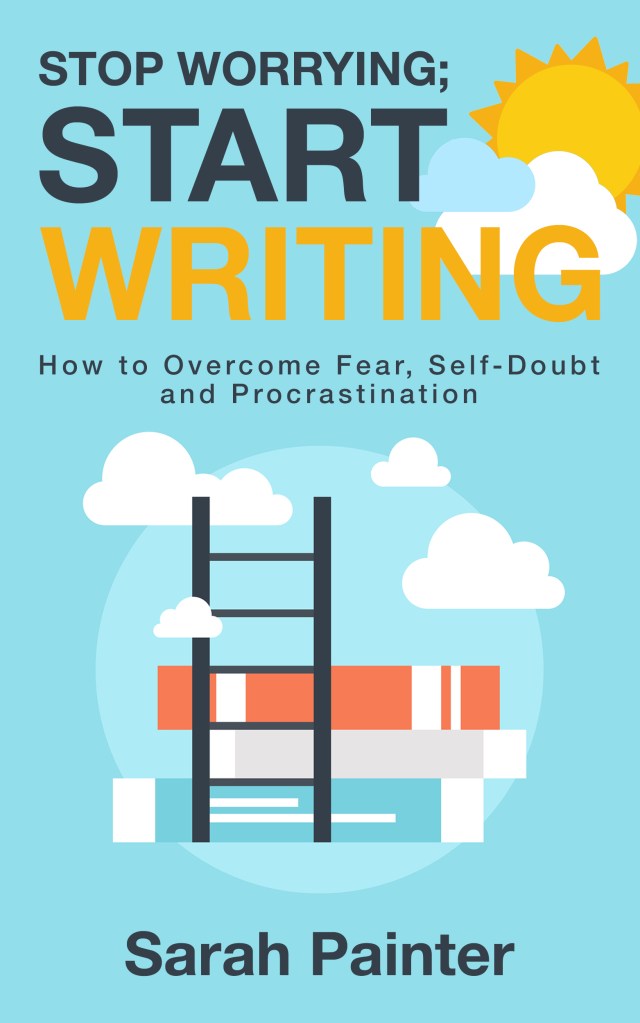
Do you want to write but can’t seem to get started? Are you struggling to finish your novel or frustrated by your slow progress? Perhaps you are starting to worry that you aren’t cut out for the writing life… Let bestselling novelist and host of the popular Worried Writer podcast, Sarah Painter, show you how to skip past negativity, free-up writing time, cope with self-doubt, and beat procrastination. Along with mega successful authors such as C.L.Taylor, Mark Edwards, and Julie Cohen, Sarah will show you how to: smash writing blocks to finish stories faster, handle self-doubt so that it doesn’t stop you creating, trick yourself into being more productive, schedule your time, and much more. Packed with honest, supportive, and hard-won advice, this is your practical guide to getting the work done. Don’t let creative anxiety kill your writing dreams: Stop Worrying and Start Writing today!
‘Inspiring, comforting, warm and wise. Both new writers and established authors will find something helpful here.’ Keris Stainton, YA author.
‘The best book on writing and productivity I have read in a long time. It tackles the fear and self-doubt we all feel when it comes to our writing in such an engagingly honest way, that there are times when I was laughing aloud because here was someone who truly understood. Written with such heart, Sarah, in her characteristically kind, and gentle way that listeners of The Worried Writer podcast have come to love and appreciate, offers solid, actionable advice that will inspire you to approach your writing with enthusiasm and renewed determination!’ Lily Graham, author of The Cornish Escape
Quotes
Chapter 1
“When you are battling fear and self-doubt, taking small steps is the only way forward and, crucially, once you are moving it is easier to keep going.” — page 1
“To everybody else, I say a few books on the craft of writing can be useful. The main thing to remember is that they are not rules, just guidelines. Each written from a particular writer’s viewpoint (and filtered through their own experience, education, and personal process). Take what works for you and ignore what doesn’t.” – page 5
“Finally, a word of warning. Reading about writing and following courses on craft and researching can all, very easily, become methods of procrastination. There is a time for learning and it goes hand-in-hand with actually writing.” — page 7
Chapter 3
“The fear of failure that rears up and stops us from finishing a book is a self-defence mechanism. If we don’t finish the work we cannot send it out to be judged (or read it as a completed story and judge it ourselves).” –page 17
Chapter 4
“If you focus on the end result (a finished novel or, worse yet, a good finished novel) you have a very long and lonely road ahead. Days and weeks and months, maybe even years, before you achieve something. Focus on today instead. What counts as a win today? An hour of writing? One hundred new words? Opening your document and thinking about your story?” — page 23
“Nobody is going to make you practise your writing. Nobody is going to care if you never get down to it and work on your craft and finish your book. Nobody, that is, except you…So, start practising.” — page 24
Chapter 5
“Setting a firm deadline and a timeline for your list is vitally important, otherwise it will simply languish.” — page 26
“It might feel counter-intuitive but productivity is usually improved by being kinder to yourself, not harsher.” — page 27
Chapter 8
“If you don’t MAKE the time you will NEVER write a novel.” — page 43
“Something which helped me was to remember that my writing appointment was just that. An appointment to write. Yes, I usually have a daily word count I aim for, but the appointment to write is not an appointment to ‘write 1000 words.’ I am, instead, making a commitment to spend that time writing. If I tell myself that all I have to do is show up at the keyboard and focus on my book for thirty minutes or an hour and that even if I stare at a blank screen (or free-write about how stuck I am, producing zero usable words for the book) then it takes the pressure off.” — page 48
Chapter 9
“Finally, it’s good to remember and to truly understand–deep in your bones–that this is how books are written. They are written in small chunks. Word by word. Sentence by sentence. Paragraph by paragraph.” — page 59
Chapter 10
“Finding the line between protecting your vision and voice and taking criticism that will genuinely improve your book is something which definitely gets easier with experience. The only way is to keep going. Keep writing lots, and your own voice will get stronger, your grasp of the craft will improve and you will also become more desensitised to the-often painful-business of discussing your work.” — page 63
“So, be careful to whom you reveal your writing ambitions, and remember that you don’t have any obligation to tell people, even if they ask. Having said all that, I do think support is important, so do tell trusted people who will support you and cheer you on.” — page 64
Chapter 11
“I can honestly say that the writing friends I have made are absolutely vital to my continuing productivity and happiness. Nobody understands writing (and the heart-breaking/crazy/uncertain world of publishing) like other writers and nobody else (except your spouse if you are exceptionally lucky) will happily discuss plot problems, character arcs, and POV headaches for hours on end.” — page 78
Chapter 12
“I mention my failures for two reasons: Firstly, so that you know it’s normal to fail. Writing is a continual process of failing and the quicker you get comfortable with that reality, the easier, happier, and more productive you will be! Secondly, because sometimes it is okay to stop working on a book. Yes, finishing what you start is an essential skill and one you must develop, it is also true that some pieces of writing won’t become finished novels.” — page 82
“So, back to your manuscript and your block. First off, accept that writing a book is hard and it is perfectly acceptable to have bad days or weeks. Take that guilt or that feeling of ‘not being a proper writer’ and shove it firmly to one side.” — page 83
How to Break Through the Wall (pages 83-91
- Ignore the advice above and tell yourself it’s easy and fun
- Reignite your passion
- Recognise self-censorship and fear of judgment
- Stuck on a particular scene or don’t know where the story goes next? Skip ahead.
- Play with POV
- Take a ‘high level’ approach to character
- Change of scenery
- When you can’t even begin…develop an idea-gathering habit
- What if you finish a book and you can’t start a new one? It might be part of the natural cycle of creativity and rest
Chapter 13
“Bad writing days. We all have them.” — page 93
(we must choose comfort or courage) “I can’t have both. It’s supposed to be scary. I need to choose courage because that’s where creation lies.” — page 94
Chapter 14
“The truth of the matter is this: writing is not digging ditches. You can force yourself to turn up to the computer and you can even force your fingers to tap the keys, but if your brain (your subconscious, your soul) isn’t capable, then you won’t be able to write. It’s important to recognise this and to fully accept that you are not a bad writer or a lazy person; sometimes your psyche will not be able to manage the deep creative work of writing and that is not your fault.” — page 97
Chapter 15
“Learning as a writer is essential (and one of the wonderful aspects of the craft – we will never know it all!) and it’s good to stay open to new ideas, alternative ways of doing things, and aspects of the craft (and process) of writing that we might not have considered. It is, however, your writing and writing life that matters. You are never learning the ‘right’ way to write, tell stories, or live a creative life; you are discovering your own way to do these things. Be confident in your own instincts to say ‘this works for me’ or ‘this makes sense to me’ and ‘this doesn’t.'” — page 103
Chapter 16
“At some point, if I ever wanted to be free of this continual self-doubt and second-guessing and terrible neediness, I was going to have to decide that I was good enough. That I deserved to be a writer. Not that I was instantly amazing and deserved success, not that I deserved to be universally adored, but that my words, my writing, my voice, my stories were worth creating. For myself.” — page 107
All right. That is all from me for today. Thank you so much for stopping by, and I’ll be back soon with more geeky content.

 Free State of Geek