
Hey all, Sam here.
It’s the first Friday of a new month, and that means it is time to talk about some creativity prompts. While I use them for writing stories or scenes, and just working on my craft, I can see how someone could be inspired to create art or poetry or music or whatever from these prompts as well.
The basic set-up of the Weekend Writer series of posts is that for the first Friday of the month, I share some prompt ideas to spark that creative drive. Then on the final Friday of the month, I will write up a post where I share some snippets from my own writing. For the rest of the Fridays for the month, it’s all about doing a deep dive into some aspect of creative writing. That could be a book on writing craft, or a video about creative writing, or a panel or seminar, or even just a general discussion about some element of creativity and creative writing.
I really enjoy this series of blog posts, possibly more than any other, but this is also the blog series that takes the most time and work to put together. I just hope that others find it as useful as I do.
All right, let’s go ahead and jump into the prompts. I have a variety of prompt generation methods, some that are technically targeted towards TTRPGs but I feel they still work quite nicely for general creative writing.
June Prompts
Story Engine Deck

Prompt: A Cleric Wants to Obtain a Rare Spell Component from A Corrupted Ruin But They Must Convince an Enemy to Help Them.
This prompt comes from this storytelling deck from The Story Engine, which is a prompt and idea generating tool that I adore for both creative writing and for TTRPG plotting.
Tarot/Oracle Deck

Prompt: Anomaly, Soar, Perspective
Once again, I used my Urban Crow Oracle Deck by MJ Cullinane for this prompt. I really like using this oracle deck, because the card names are different from a tarot deck. I do have a few different tarot decks as well, and I might use those at some point for future draws, but for now I’m really enjoying my crow deck.
Roll & Play

Prompt: You have the gods favor. Now, you…receive a divine weapon directly from the gods.
This month I decided to roll the dice on the Divine Blessings page in the Roll & Play book. You can use the dice I rolled, or if you have your own d20, you can roll on the chart yourself. Or heck, if you want to then you can just choose whichever option sparks your interest.
Sidequest Decks

Prompt 1: Dream Logic – a vengeful dark wizard hits the main character with a Sleeping Beauty curse. Now they must navigate their own dreams to find the spirit forcing them to slumber.
Prompt 2: Hostile Takeover – The coffee (or other substance) delivered to the teacher’s lounge/offices has been tainted. Those who drank it have had their powers muted. Evil forces wish to weaken the school’s defenders before attacking.
The Sidequest decks from Inkwell Ideas are another wonderful accessory designed for TTRPGs, but can easily be used for writers as well. This time around I went back to the Arcane Academy deck, and again, I went with two options as prompt inspiration. You can use either option, and you can either use the basic concept at the top of the card, or you can use the various encounters at the bottom of the card to expand upon the adventure/story further.
The Oracle Story Generator
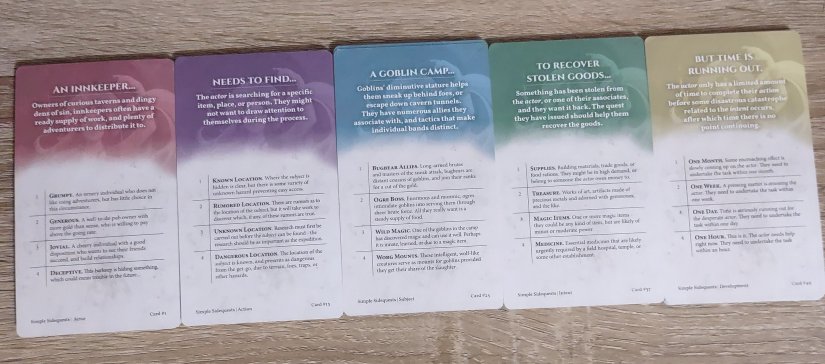
Prompt: An Innkeeper Needs to Find a Goblin Camp to Recover Stolen Goods but Time is Running Out.
Finally, we have a new addition to the prompt generation: The Oracle Story Generator by Nord Games. They have a Character Generator as well, but that one won’t be shipped out for another couple months. I’ve only looked through a few of these cards before writing up this post, so I’m pretty excited to delve further into the story options with these decks. With this prompt, you can make it even more specific by either rolling a four-sided die for each card, or by simply choosing which option you like best.
As always, when we reach the final Friday of the month, I’ll be sharing some snippets from what I’ve been writing over the past weeks. If you choose to create anything based on these prompts (or even if you don’t), feel free to share your creative projects with me for the last Friday of the month too. I’d love to celebrate whatever creative progress you’re making too!
All right…and now with the prompts out of the way, let’s go ahead and jump into the next chapter of our writing craft deep dive.

SAVE THE CAT!® by Blake Snyder is a popular screenwriting book series and storytelling methodology used by screenwriters, directors, and studio execs across Hollywood. Now, for the first time ever, bestselling author and writing teacher, Jessica Brody, takes the beloved Save the Cat! plotting principals and applies them to the craft of novel writing in this exciting new “workshop style” guide, featuring over 20 full beat sheets from popular novels throughout time.
Whether you’re writing your first novel or your seventeenth, Save the Cat! breaks down plot in an easy-to-follow, step-by-step method so you can write stories that resonate! This book can help you with any of the following:
Outlining a new novel
Revising an existing novel
Breaking out of the dreaded “writer’s block”
Fixing a “broken” novel
Reviewing a completed novel
Fleshing out/test driving a new idea to see if it “has legs”
Implementing feedback from agents and/or editors
Helping give constructive feedback to other writersBut above all else, SAVE THE CAT! WRITES A NOVEL will help you better understand the fundamentals and mechanics of plot, character transformation, and what makes a story work!
Chapter Eight: Dude with a Problem – Surviving the Ultimate Test
We have another story genre exploration with this chapter, this time focusing on the Dude with a problem story. As with the rest of the chapters, this one opens with the inclusion of spoiler tags for the books that Brody will be discussing in this chapter.
So what is the Dude with a Problem story? Well, as Brody puts it, as much as we love stories about chosen ones and those destined to save the world, sometimes we readers just want to be inspired by an ordinary person rising up against extraordinary circumstances. Basically, we want an ordinary person facing an extraordinary challenge.
The ordinary person is not a superhero, they don’t have abilities that make them powerful or special or on some destined path for greatness. They are simply someone minding their own business when they are dragged into trouble and a situation they did not expect or want.
And this ordinary person may not seem to be properly skilled to handle the situation, but eventually they rise to the occasion and accomplish things they never thought possible.
All stories that fit into the Dude with a Problem genre are about a long man, woman, teen, animal, or group who faces incredible odds and may often include them struggling to hold onto their own sanity.
But remember, problems are relative. You gotta match your problem with the right dude (or dudette), taking into account your dude’s given background, characteristics, and skill set. It’s the relative size of the challenge that makes the stories work.
page 161
It should also be noted that stories that fit into the Dude with a Problem story genre work better if there is some sort of external bad guy, even if they are working behind the scenes to throw out new challenges for the hero and friends. Brody points out that the badder the bad guy is the greater the heroics by the hero.
Also, the reader’s satisfaction from this sort of story comes from when our Dude with a Problem uses whatever skills they do have to outsmart whoever the bad guy is.
As with the previous story genre, the Dude with a Problem also has three main story elements for success: 1) an innocent hero, 2) a sudden event, and 3) a life-or-death battle.
For your innocent hero: they are someone who gets drawn into the problem without asking for it. Readers like these kind of stories because they could find themselves in the same situation and become the hero. The Dude with a Problem story is one of survival, not of punishment for a crime committed.
The second element is a sudden event, and it should be sudden. It comes from nowhere and forces the hero to come to terms with this change in circumstances.
And the third element is a problem worthy of this story, some sort of life-or-death battle in which an individual, group, or society’s existence is at stake. Basically, the problem should be BIG.
Brody does point out that there is often another element in the Dude with a Problem story genre is a love interest. While they are not always there, when they are they are typically used as champions or cheerleaders for the hero. The love interest is a B Story character who ends up helping the hero believe in themselves and find the strength they need to take on this problem they face.
This leads to talking about this moment called the eye-of-the-storm, and it often features tender scenes between the hero and the love interest. Brody says this is where the action slows down for a moment and the characters have a chance to reflect and relax. If there is action all the time, then it starts to get wearying for the reader.
Even when the storm is still brewing, it is very effective to take a break, which can also solidify and increase love stories and friendships.
In the end, all Dude with a Problem novels are about the triumph of the human spirit. Our dude has survived! Or if he hasn’t, there’s a good, compelling reason for it. A reason that really makes us think. Dude with a Problem stories reminds us that we, average humans, are actually a lot less average than we thought. We have hidden strengths. Hidden talents. And when put to the test, we persevere! We overcome! We triumph!
Reading these stories make us feel alive and inspired.
page 164
On Page 165, Brody includes a list of popular dude with a problem novels, and then pages 165-175 includes a story beat breakdown of a novel within the genre.
Well, that is all from me for today. Thank you so much for stopping by, and I’ll be back soon with more geeky content.

 Free State of Geek
3 thoughts on “Weekend Writer: Save the Cat! Writes a Novel Chapter Eight by Jessica Brody (and June Prompts)”